Sperm mitochondria are the hidden energy engines behind male fertility.
Most men think fertility is only about testosterone or sperm count, but sperm need more than numbers — they need power. Deep inside each sperm cell, mitochondria help produce the energy required for movement, survival, and the journey toward the egg.
When this energy system is strong, sperm motility can be better supported. But when mitochondrial function is weak or oxidative stress rises, sperm quality may suffer at a deeper cellular level.
Male fertility is not just hormonal.
It is cellular.
Most men think fertility begins and ends with testosterone.
But your sperm are not just numbers on a test result.
They are living cells that need energy, protection, direction, and strength.
Deep inside each sperm cell is a small but powerful energy system called the mitochondria. Think of mitochondria as the biological engine that helps sperm move with purpose. If that engine is weak, sperm motility can suffer. If oxidative stress rises, sperm quality can decline. And if mitochondrial damage builds up, fertility may be affected again at a deeper cellular level.
A man can have testosterone in range and still have fertility challenges. He can have sperm present in his semen and still have poor movement, weak sperm quality, or sperm DNA damage. Male fertility is not only about how many sperm are there. It is about whether those sperm are strong enough, healthy enough, and energetic enough to complete the mission.
And that mission demands power.

Male Fertility Is More Than Sperm Count
When most men hear the words “male fertility,” they immediately think about sperm count.
That makes sense. Sperm count matters. If there are not enough sperm, conception can become more difficult. But sperm count is only one piece of the bigger fertility picture.
A proper understanding of male fertility includes several key areas:
Sperm count: how many sperm are present.
Sperm motility: how well sperm move.
Sperm morphology: the shape and structure of sperm.
Sperm DNA quality: the integrity of the genetic material carried by sperm.
Oxidative stress balance: whether sperm are being protected or damaged at the cellular level.
Energy production: whether sperm have enough power to move effectively.
This is where many men get the picture wrong.
A high sperm count means less if the sperm do not have the energy to move properly. Fertility is not just about quantity. It is also about quality, movement, and function.
Sperm are not passive cells floating around randomly. They are highly specialized cells designed for one biological mission: to reach and fertilize the egg. That requires movement. Movement requires energy. And energy depends heavily on the sperm’s internal power system.
That is where sperm mitochondria become important.

What Are Sperm Mitochondria?
Mitochondria are often called the powerhouses of the cell because they help produce energy. In sperm, mitochondria are especially important because sperm need energy to move forward, survive inside the reproductive tract, and take part in the fertilization process.
The mitochondria in sperm are located in the midpiece, the section between the head and the tail. This placement matters. The sperm tail needs energy to move, and the mitochondria are positioned close to the machinery that helps power that movement.
In simple terms:
Mitochondria help give sperm the energy they need to move.
For Alpha Circle Club, think of it this way:
The sperm cell has a mission. The mitochondria are part of the engine system that helps drive that mission forward.
Scientific reviews have described sperm mitochondria as important for sperm function, including energy production for motility, reactive oxygen species regulation, calcium signalling, hyperactivation, and processes linked to fertilization.
This makes mitochondria more than a minor detail. They are a serious part of the male fertility conversation.
Why Sperm Motility Depends on Energy
Sperm motility means the ability of sperm to move. But not all movement is equal.
Some sperm may move in circles. Some may twitch without making useful progress. Some may barely move at all. What matters most for fertility is progressive motility — the ability of sperm to move forward effectively.
Forward movement is essential because sperm must travel through the female reproductive tract to reach the egg. That journey is not easy. It requires endurance, coordination, and energy.
Motility is not random movement.
Motility is powered movement.
Sperm need energy for several important actions:
Moving forward.
Surviving inside the female reproductive tract.
Undergoing hyperactivation, a more forceful movement pattern needed near the egg.
Taking part in the acrosome reaction, which helps sperm interact with the egg.
Supporting the final steps required for fertilization.
Research has connected impaired mitochondrial activity with reduced sperm motility and lower fertilizing capacity, which supports the idea that sperm energy production is closely linked to fertility potential.
This is why the conversation must go deeper than “increase your sperm count.”
A man trying to improve fertility should also ask:
Are my sperm moving well?
Are they protected from oxidative damage?
Do they have strong cellular energy?
Is my lifestyle supporting or attacking sperm quality?
Because when sperm cannot move properly, the mission becomes harder.
The Link Between Mitochondrial Dysfunction and Weak Sperm
When mitochondria are healthy, they help sperm produce energy and maintain function. But when mitochondria become damaged or dysfunctional, sperm may struggle.
Mitochondrial dysfunction can be linked with reduced energy production, increased oxidative stress, weaker sperm movement, and possible sperm DNA damage. Recent reviews have described mitochondrial dysfunction as an important factor in reduced sperm function and male infertility.
That does not mean mitochondria are the only factor in fertility. Male fertility is influenced by hormones, testicular function, lifestyle, heat exposure, inflammation, age, varicocele, toxins, sleep, nutrition, alcohol, smoking, medication history, and other medical issues.
But mitochondria deserve attention because they sit at the centre of one of the most important fertility questions:
Do your sperm have the energy to perform?
When the sperm’s energy system breaks down, fertility can become weaker from the inside out.
A man may not feel this happening. He may look normal, train hard, work hard, and feel masculine. But sperm health is not always visible from the outside. That is why fertility must be approached with discipline, awareness, and data.
The body gives results based on conditions.
If the internal environment is poor, sperm quality can suffer.
Oxidative Stress: The Silent Attack on Sperm Health
Oxidative stress is one of the most important concepts in male fertility.
Reactive oxygen species, often called ROS, are not always bad. In the right amount, they play normal roles in sperm function, including sperm maturation and fertilization-related processes. But when ROS levels become too high, oxidative stress can damage sperm.
The PubMed-reviewed article on sperm mitochondria explains that reactive oxygen species can support normal sperm processes in physiological amounts, but excess oxidative stress can contribute to sperm dysfunction.
This balance matters.
Too little oxidative activity may interfere with normal sperm function. Too much oxidative stress may damage the sperm cell.
When oxidative stress becomes excessive, it may harm sperm membranes, proteins, and DNA, and it has been linked with impaired motility and sperm dysfunction.
For a man who wants to become a father, this is not a small issue.
Oxidative stress can be influenced by many factors, including:
Smoking.
Excess alcohol.
Poor diet.
Obesity.
Inflammation.
Poor sleep.
Environmental toxins.
Excess heat exposure.
Chronic stress.
Overtraining or poor recovery.
This is why lifestyle matters.
Not because lifestyle is magic.
But because lifestyle helps shape the environment where sperm are produced.
Oxidative stress is not just a health buzzword. For sperm, it can become biological sabotage.
If a man is serious about fertility, he should be serious about reducing unnecessary damage.
That means protecting sleep. Improving food quality. Avoiding overheating. Cutting down harmful habits. Managing stress. Training intelligently. Getting checked if something feels wrong.
The goal is not perfection.
The goal is to create better conditions.
Sperm DNA Damage and Fertility
Sperm are not only swimmers.
They are carriers of genetic material.
That means fertility is not only about whether sperm can reach the egg. It is also about the quality of the biological message the sperm carries.
Sperm DNA damage has been linked with male infertility and poorer reproductive outcomes. Oxidative stress is considered a major contributor to sperm DNA fragmentation, although male fertility is complex and should be assessed properly by qualified professionals.
This is where men need to move beyond ego.
Fertility is not something to guess about.
A man may assume he is fertile because he feels healthy, trains in the gym, or has no obvious symptoms. But semen quality can only be properly assessed through testing.
That is why a semen analysis can be powerful. It gives real information on sperm count, motility, morphology, semen volume, and other important markers. Depending on the situation, a doctor may also recommend hormone testing, sperm DNA fragmentation testing, or further investigation.
Healthy sperm are not just fast.
They must also carry the right biological message.
That is a powerful standard.
Not fear. Not panic. Responsibility.
Can You Improve Sperm Mitochondrial Health Naturally?
This is the question many men will ask:
Can I improve sperm mitochondria naturally?
The honest answer is that no lifestyle change can guarantee fertility success. Male fertility can involve medical conditions that need proper diagnosis and treatment. But lifestyle can still matter because sperm are produced inside the environment created by the body.
You cannot control every fertility factor.
But you can control many of the conditions your sperm are being produced in.
Here are practical areas to focus on.
1. Protect Your Sleep
Sleep affects recovery, hormones, energy, stress regulation, and overall health. Poor sleep can weaken discipline and increase the likelihood of bad food choices, poor training, stress, and low recovery.
For fertility, sleep should be treated as a foundation.
A man who sleeps badly, eats badly, and lives under constant stress should not be surprised if his body is not operating at its best.
2. Reduce Heat Exposure
Sperm production is sensitive to heat. The testicles sit outside the body for a reason: they need a cooler environment than core body temperature.
Men trying to support fertility should be careful with frequent hot tubs, saunas, very hot baths, laptops placed directly on the lap, and tight heat-trapping clothing.
This does not mean living in fear.
It means respecting biology.
3. Stop Smoking
Smoking is one of the clearest lifestyle enemies of fertility. It is associated with oxidative stress and poorer semen quality. If a man is serious about fatherhood, quitting smoking is not just a health decision. It is a responsibility decision.
Quitting is hard, but fatherhood requires harder things than quitting a habit.
That line deserves to be remembered.
4. Reduce Alcohol
Heavy alcohol intake can negatively affect health, hormones, sleep, liver function, recovery, and fertility-related markers.
A man does not need to be perfect, but if he is trying to conceive, reducing alcohol is a serious move.
The Alpha Standard is simple:
If something is damaging your future, reduce it or remove it.
5. Eat More Antioxidant-Rich Foods
Because oxidative stress is a major fertility issue, nutrition matters.
A diet that supports fertility should include nutrient-dense foods such as:
Colourful fruits.
Vegetables.
Quality protein.
Healthy fats.
Mineral-rich foods.
Whole-food carbohydrates.
Foods rich in vitamin C, vitamin E, zinc, selenium, folate, and other fertility-supporting nutrients.
This does not mean one “superfood” will fix fertility.
It means the full diet should support the body instead of draining it.
6. Exercise, But Do Not Destroy Yourself
Exercise can support metabolic health, weight management, mood, circulation, and hormone health. But overtraining without recovery can become another stressor.
For fertility, the aim is not to punish the body.
The aim is to build the body.
Strength training, walking, mobility work, and sensible conditioning can all be part of a fertility-supportive lifestyle.
Train like a man with a mission.
Recover like a man who understands the mission.
7. Manage Stress
Stress is not only mental. It has physical effects.
Chronic stress can influence sleep, hormones, food choices, inflammation, recovery, and discipline. If stress is constant, the body may spend more time surviving than building.
A man trying to improve fertility should not ignore his mental state.
Calm is not weakness.
Calm is control.
8. Get Tested Instead of Guessing
If you are trying to conceive or worried about fertility, get a semen analysis.
Do not build your plan on assumptions.
Do not rely on ego.
Do not say, “I feel fine, so I must be fertile.”
A semen analysis can provide useful information about sperm count, motility, morphology, and other semen parameters. If results are abnormal, a healthcare professional can advise on the next steps.
Real men do not guess. They get data.
The 90-Day Sperm Energy Reset
Sperm health is not built overnight.
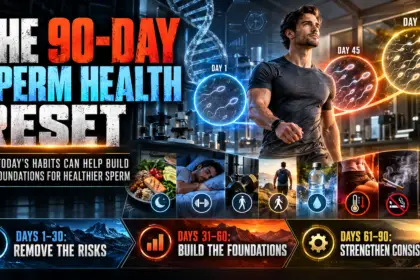
Sperm production takes time. Many sources describe sperm development as taking roughly two to three months, with commonly cited estimates around 64–74 days for sperm production and maturation.
That is why a 90-day approach makes sense.
Not because 90 days is magic.
But because it gives the body enough time to respond to repeated lifestyle choices.
This is where Alpha Circle Club can create a powerful message:
Your sperm health is built through what you repeatedly do, not what you occasionally intend to do.
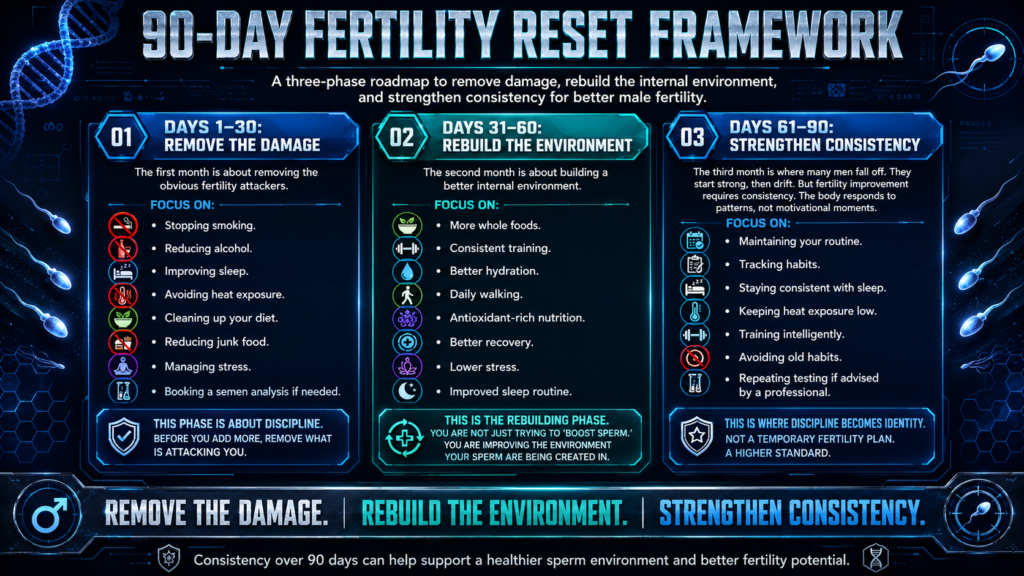
Here is a simple 90-day structure.
Days 1–30: Remove the Damage
The first month is about removing the obvious fertility attackers.
Focus on:
Stopping smoking.
Reducing alcohol.
Improving sleep.
Avoiding heat exposure.
Cleaning up your diet.
Reducing junk food.
Managing stress.
Booking a semen analysis if needed.
This phase is about discipline.
Before you add more, remove what is attacking you.
Days 31–60: Rebuild the Environment
The second month is about building a better internal environment.
Focus on:
More whole foods.
Consistent training.
Better hydration.
Daily walking.
Antioxidant-rich nutrition.
Better recovery.
Lower stress.
Improved sleep routine.
This is the rebuilding phase.
You are not just trying to “boost sperm.”
You are improving the environment your sperm are being created in.
Days 61–90: Strengthen Consistency
The third month is where many men fall off.
They start strong, then drift.
But fertility improvement requires consistency. The body responds to patterns, not motivational moments.
Focus on:
Maintaining your routine.
Tracking habits.
Staying consistent with sleep.
Keeping heat exposure low.
Training intelligently.
Avoiding old habits.
Repeating testing if advised by a professional.
This is where discipline becomes identity.
Not a temporary fertility plan.
A higher standard.
When Should a Man Get Tested?
A man should consider getting checked if he and his partner have been trying to conceive without success, if he has known risk factors, or if he is concerned about sperm quality.
Testing may also be useful if there is a history of:
Low testosterone symptoms.
Testicular injury.
Varicocele.
Steroid or TRT use.
Chemotherapy.
Smoking.
Heavy alcohol use.
Previous infections.
Heat exposure.
Poor semen analysis results.
Difficulty conceiving.
A semen analysis is not something to fear.
It is information.
And information gives you power.
If results are not ideal, that does not mean the mission is over. It means you now have data and can take the next step with a doctor, urologist, fertility specialist, or qualified healthcare professional.
The weak man avoids the truth.
The serious man investigates it.

The Alpha Standard for Male Fertility
Male fertility is not weakness.
It is responsibility.
It is the ability to look at your lifestyle, your habits, your health, and your future with honesty.
Too many men wait until there is a problem before they start caring about sperm health. But the stronger move is to prepare early.
Protect your body.
Protect your energy.
Protect your sleep.
Protect your sperm.
Protect your future family.
This is not about panic.
This is about ownership.
Your sperm are not just cells.
They carry your future.
And if sperm need energy, movement, protection, and strength, then the man producing them must live with the same standard.
Energy.
Movement.
Protection.
Strength.
That is the Alpha Standard.
Final Thoughts: Fertility Starts at the Cellular Level
Most men think fertility is about testosterone.
Some men think it is only about sperm count.
But the deeper truth is this:
Male fertility is cellular.
Sperm need energy to move. They need protection from oxidative stress. They need healthy structure. They need strong DNA integrity. They need the right internal environment.
Sperm mitochondria are part of that hidden system.
They help power the movement that makes fertility possible. When that energy system is damaged, sperm function may suffer. When oxidative stress rises, sperm quality can be affected. When a man neglects his health, his fertility may pay the price.
But when a man takes ownership, everything changes.
He stops guessing.
He stops ignoring warning signs.
He stops treating fertility like a woman’s issue.
He starts acting like a man with responsibility.
Ready to take male fertility seriously?
Start with the basics.
Protect your sperm.
Improve your lifestyle.
Reduce oxidative stress.
Support your cellular energy.
Get tested if you are concerned.
Build the conditions your future deserves.
Male fertility is not weakness.
It is responsibility.
And responsibility is the Alpha Standard.
Medical note: This article is for educational purposes only and is not medical advice. Men concerned about fertility, testosterone, semen quality, or conception should speak with a qualified healthcare professional or fertility specialist.



No spam. Unsubscribe anytime.