
A semen analysis is one of the most important tests a man can take when fertility matters.
It is simple.
It is practical.
And it gives real information instead of guesswork.
Many men assume their fertility is fine because they have normal erections, normal ejaculation, strong libido, or good physical strength.
That is not enough.
A man can perform well sexually and still have low sperm count, poor sperm movement, abnormal sperm shape, or other semen issues.
That is why a semen analysis matters.
It helps measure the quantity and quality of semen and sperm. It can show whether sperm are present, how many there are, how well they move, and whether their shape appears within expected ranges.
For a man who wants children, this test is not embarrassing.
It is responsible.
At Alpha Circle Club, the message is built around discipline, self-command, and masculine ownership. A man who wants legacy should not leave fertility to assumptions. He should get facts, understand his body, and act with clarity.
This guide explains what a semen analysis is, what it checks, how to prepare, how to understand results, what abnormal results may mean, and what to do next.

What Is a Semen Analysis?
A semen analysis is a laboratory test that evaluates semen and sperm.
Semen is the fluid released during ejaculation.
Sperm are the male reproductive cells inside semen that carry genetic material needed to fertilize an egg.
A semen analysis is often used as a male fertility test when a couple is having trouble getting pregnant.
It may also be used after a vasectomy to confirm that sperm are no longer present in the semen.
For fertility, the test gives information about several key markers.
It can measure semen volume, sperm concentration, total sperm count, sperm movement, sperm shape, and sometimes other semen characteristics.
This helps doctors understand whether a male factor may be contributing to infertility.
It does not answer every fertility question by itself.
But it is one of the best starting points.
Why Men Should Not Fear Fertility Testing
Many men delay fertility testing because of pride.
Some feel embarrassed.
Some think a sperm test attacks their masculinity.
Some assume the woman should be tested first.
That mindset needs to change.
A semen analysis is not a judgment of manhood.
It is a measurement.
A man does not become weaker because he checks his health. He becomes stronger because he stops guessing.
If a couple is trying to conceive, both partners matter.
The male side deserves attention just like the female side.
A man who avoids testing may waste time, increase pressure on his partner, and delay treatment that could help.
That is not leadership.
Leadership means stepping forward.
When Should a Man Get a Semen Analysis?
A man should consider a semen analysis if a couple has been trying to conceive for 12 months without pregnancy.
If the female partner is 35 or older, many clinicians recommend evaluation sooner, often after 6 months of trying.
Testing may also be wise earlier if the man has known risk factors.
These include past testicular injury, undescended testicle, varicocele, anabolic steroid use, testosterone therapy, cancer treatment, reproductive surgery, sexual function problems, infections, low libido, or abnormal hormone symptoms.
A man may also choose fertility testing before trying for children if he wants a clearer picture of his reproductive health.
That can be especially useful if he is older, has used hormones, has a medical history, or wants to plan ahead.
Testing early does not mean panic.
It means preparation.
Why a Semen Analysis Is Usually the First Male Fertility Test
A semen analysis is usually the first major male fertility test because sperm quality is central to male fertility.
Before advanced testing, a doctor needs to know what is happening in the semen.
Are sperm present?
Is the sperm count low?
Are sperm moving properly?
Is semen volume low?
Is morphology abnormal?
Are there signs that suggest infection or another concern?
These questions matter.
A man may need hormone testing, ultrasound, genetic testing, infection testing, or specialist evaluation later.
But the semen analysis often gives the first direction.
It helps separate guesswork from real information.
What a Semen Analysis Checks
A semen analysis looks at several semen and sperm markers.
Each marker gives a different piece of the fertility picture.
No single number tells the full story.
A man may have one abnormal value and still be able to conceive.
A man may have several abnormal values and need treatment.
A doctor should interpret the full report with the man’s history, partner’s fertility, and how long the couple has been trying.

Semen Analysis Test Table
| Test Marker | What It Means | Why It Matters |
| Semen volume | Amount of fluid in the sample | Low volume may suggest collection issues, dehydration, blockage, or ejaculation concerns |
| Sperm concentration | Number of sperm per milliliter | Helps identify low sperm concentration |
| Total sperm count | Total sperm in the full sample | Gives a broader count across the entire ejaculate |
| Total motility | Percentage of sperm that move | Shows how many sperm have movement |
| Progressive motility | Sperm moving forward effectively | Important because sperm must travel toward the egg |
| Morphology | Sperm shape and structure | Abnormal shape may affect movement or fertilization |
| pH | Acidity or alkalinity of semen | May help identify gland or infection-related concerns |
| Liquefaction | How semen changes after ejaculation | Abnormal liquefaction may affect sperm movement |
| White blood cells | Possible inflammation or infection marker | May suggest further testing is needed |
Sperm Count
A sperm count test is one of the main parts of a semen report.
It checks how many sperm are present.
Doctors may look at sperm concentration and total sperm count.
Sperm concentration tells how many sperm are present in each milliliter of semen.
Total sperm count tells how many sperm are in the entire sample.
A low sperm count may make pregnancy harder because fewer sperm are available to reach the egg.
But count is not everything.
A man may have a good count but poor motility.
Another man may have a lower count but stronger movement.
This is why the full semen analysis results matter.
Sperm Motility
Sperm must move.
A sperm motility test checks how well sperm move in the semen sample.
This is important because sperm need to travel through the female reproductive tract to reach the egg.
Motility can be total or progressive.
Total motility includes sperm that show movement.
Progressive motility focuses on sperm that move forward in a useful direction.
Progressive movement is especially important for natural conception.
A sperm cell that only shakes or moves in circles is not as useful as one that moves forward with purpose.
Sperm Morphology
Sperm morphology refers to sperm shape.
A healthy sperm has a head, midpiece, and tail that support movement and fertilization.
Many sperm in a sample may have abnormal shapes.
That does not always mean a man is infertile.
Morphology can be complex and should be interpreted carefully.
A low morphology result may matter more when combined with low count, poor motility, infertility history, or other abnormal findings.
Men should not panic over morphology alone.
They should discuss the full report with a qualified clinician.

Semen Volume
Semen volume is the amount of fluid released in the sample.
Low semen volume can happen for several reasons.
It may be due to incomplete collection, short abstinence time, dehydration, retrograde ejaculation, blockage, low hormone levels, or prostate and seminal vesicle issues.
A single low-volume result does not always mean a serious problem.
Collection error is common.
But if low volume appears repeatedly, a doctor may investigate further.
Again, one number is not the whole story.
The pattern matters.
pH, Liquefaction, and Other Semen Markers
Semen analysis may also check pH, viscosity, liquefaction, appearance, and possible white blood cells.
These markers can give clues about the semen environment.
For example, abnormal pH may sometimes suggest issues with reproductive glands.
High white blood cells may suggest inflammation or infection.
Thick semen or delayed liquefaction may affect sperm movement.
These findings usually need medical interpretation.
A man should not try to self-diagnose from one line on a lab report.
How to Prepare for a Semen Analysis
Preparation matters because sample quality can affect results.
Clinics usually give specific instructions.
Men should follow those instructions carefully.
Common preparation instructions may include avoiding ejaculation for a recommended period before the test, using the collection container provided, collecting the full sample, avoiding lubricants unless approved, and delivering the sample quickly if collected at home.
The exact instructions may vary by clinic.
Do not guess.
Ask the lab or doctor what they want.
A man who wants accurate results should treat the test seriously.

Semen Analysis Preparation Table
| Preparation Step | Why It Matters |
| Follow abstinence instructions | Too little or too much abstinence can affect semen results |
| Use the proper sterile container | Prevents contamination and sample problems |
| Collect the full sample | Missing part of the sample can affect volume and count |
| Avoid unapproved lubricants | Some products may harm sperm movement |
| Keep the sample near body temperature | Extreme temperatures may affect sperm quality |
| Deliver quickly if collected at home | Delays may affect motility and accuracy |
| Tell the clinic about fever or illness | Recent illness can affect semen quality |
| Report medications or hormone use | Some medications or hormones affect sperm production |
Abstinence Before the Test
Most clinics ask men to avoid ejaculation for a short period before giving a semen sample.
The exact timeframe depends on the clinic’s instructions.
This matters because ejaculation timing can affect semen volume, sperm count, and motility.
Too short of a gap may reduce count.
Too long of a gap may affect movement or increase older sperm in the sample.
Do not create your own rule.
Follow the clinic’s instructions.
Accuracy matters more than ego.
How the Sample Is Collected
A semen sample is usually collected by masturbation into a sterile container.
Some clinics provide a private collection room.
In other cases, men may collect at home and bring the sample to the lab within a specific time.
If collecting at home, timing and temperature matter.
The sample should not be exposed to extreme heat or cold.
It should usually be delivered quickly.
Again, follow the clinic’s instructions exactly.
If part of the sample is missed, tell the lab.
It is better to be honest than to get misleading results.
What If Collection Feels Embarrassing?
Many men feel uncomfortable with the collection process.
That is normal.
But discomfort should not stop testing.
Doctors and labs deal with this every day.
It is a medical process, not a personal judgment.
A man may feel awkward for a few minutes.
But the information can save months of confusion.
A mature man chooses clarity over temporary discomfort.
That is real discipline.
Can You Use a Home Sperm Test?
Home sperm tests are becoming more common.
Some may estimate sperm count or give basic fertility information.
They may be useful as a screening tool.
But they are not always the same as a full clinical semen analysis.
Many home tests do not fully evaluate motility, morphology, semen volume, pH, white blood cells, or other markers.
If a couple is struggling to conceive, a clinical test is usually more useful.
A home test may give curiosity-based information.
A lab-based semen analysis gives a stronger medical foundation.
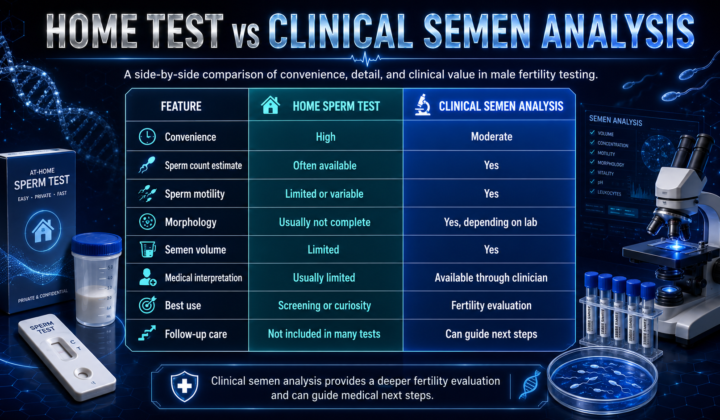
Home Test vs Clinical Semen Analysis
| Feature | Home Sperm Test | Clinical Semen Analysis |
| Convenience | High | Moderate |
| Sperm count estimate | Often available | Yes |
| Sperm motility | Limited or variable | Yes |
| Morphology | Usually not complete | Yes, depending on lab |
| Semen volume | Limited | Yes |
| Medical interpretation | Usually limited | Available through clinician |
| Best use | Screening or curiosity | Fertility evaluation |
| Follow-up care | Not included in many tests | Can guide next steps |

Understanding Semen Analysis Results
Semen analysis results can feel overwhelming.
There may be numbers, percentages, reference ranges, and terms a man has never seen before.
The first rule is simple.
Do not panic.
Semen quality can vary.
One abnormal test does not always mean permanent infertility.
A fever, illness, stress, collection error, short abstinence time, long abstinence time, heat exposure, medication, alcohol, or recent lifestyle changes can affect results.
Doctors often repeat the test before making major conclusions.
A man should review the results with a clinician rather than judging himself from one report.
Why One Test May Not Be Enough
Semen can vary from sample to sample.
That is why one semen analysis may not always give the full picture.
A doctor may recommend repeating the test, especially if results are abnormal.
This helps confirm whether the problem is consistent.
It also reduces the chance that collection issues, illness, or temporary factors caused a misleading result.
A disciplined man does not collapse after one bad result.
He repeats, reviews, and responds.

Common Semen Analysis Result Patterns
| Result Pattern | What It May Suggest | Possible Next Step |
| Low sperm count only | Reduced sperm numbers | Repeat test, lifestyle review, medical evaluation |
| Low motility only | Poor sperm movement | Check lifestyle, infection, varicocele, oxidative stress, repeat test |
| Low morphology only | Abnormal sperm shape | Interpret carefully with full fertility picture |
| Low count and low motility | Multiple sperm factors affected | Full male fertility evaluation |
| Low volume | Collection issue, blockage, retrograde ejaculation, or gland concern | Repeat test and investigate if persistent |
| No sperm seen | Azoospermia or collection issue | Repeat test and specialist evaluation |
| White blood cells elevated | Possible inflammation or infection | Medical review and possible testing |
What Low Sperm Count May Mean
Low sperm count means fewer sperm are present than expected.
This may reduce the chance of natural conception.
Possible causes include varicocele, hormone issues, heat exposure, smoking, obesity, infections, genetic factors, medications, anabolic steroid use, testosterone therapy, or unknown causes.
Low sperm count does not always mean fatherhood is impossible.
It means further evaluation may be needed.
The cause matters.
The treatment depends on the cause.
What Low Motility May Mean
Low motility means sperm are not moving as well as expected.
This can make conception harder because sperm need movement to reach the egg.
Possible causes include oxidative stress, smoking, inflammation, infection, varicocele, heat exposure, poor nutrition, obesity, toxins, and sperm structure problems.
Lifestyle changes may help some men.
Medical evaluation may be needed if motility is very low or combined with other abnormal results.
What Abnormal Morphology May Mean
Abnormal morphology means a lower percentage of sperm have typical shape.
This can affect sperm function in some cases.
However, morphology is one of the most misunderstood semen analysis markers.
A low morphology number does not automatically mean a man cannot conceive naturally.
It should be interpreted with count, motility, fertility history, and partner factors.
Men should avoid panic.
They should seek proper interpretation.
What No Sperm in Semen May Mean
If no sperm are seen in the semen sample, the condition is called azoospermia.
This requires careful evaluation.
Sometimes sperm production is extremely low or absent.
Sometimes sperm are produced but blocked from entering the semen.
These are different problems.
A man with no sperm in the sample should not assume the worst immediately.
The test may need to be repeated.
A specialist may evaluate hormones, genetics, anatomy, and possible blockages.
Some men still have treatment or sperm retrieval options depending on the cause.
Semen Analysis and Hormone Testing
A semen analysis checks semen and sperm.
Hormone testing checks the signals that help regulate sperm production.
If semen results are abnormal, a doctor may recommend bloodwork.
Common hormones may include testosterone, FSH, LH, prolactin, estradiol, thyroid markers, or others depending on the case.
This is especially important when sperm count is very low, when sperm are absent, when testosterone symptoms exist, or when there is a history of steroid or testosterone use.
Hormones and fertility are connected.
But they must be understood properly.
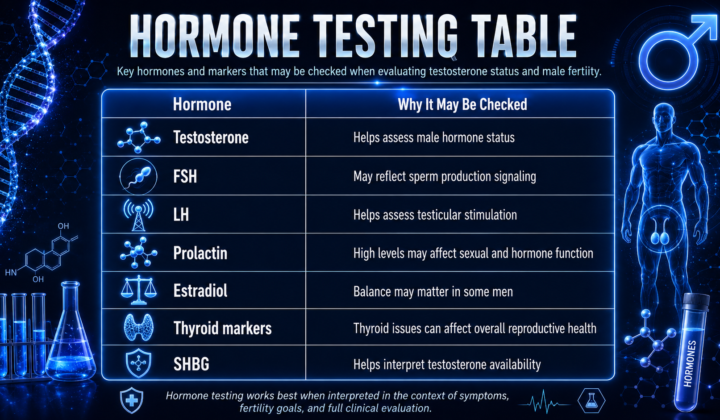
Hormone Testing Table
| Hormone | Why It May Be Checked |
| Testosterone | Helps assess male hormone status |
| FSH | May reflect sperm production signaling |
| LH | Helps assess testicular stimulation |
| Prolactin | High levels may affect sexual and hormone function |
| Estradiol | Balance may matter in some men |
| Thyroid markers | Thyroid issues can affect overall reproductive health |
| SHBG | Helps interpret testosterone availability |
Semen Analysis and Varicocele
A varicocele is an enlarged vein in the scrotum.
It may affect sperm production or sperm quality in some men.
If semen results are abnormal and a physical exam suggests varicocele, a doctor may discuss whether treatment is appropriate.
Not every varicocele needs treatment.
Not every abnormal semen result is caused by varicocele.
This is why evaluation matters.
The goal is to find the cause, not guess at it.
Semen Analysis After Testosterone or Steroid Use
Men who have used testosterone therapy or anabolic steroids should take semen analysis seriously.
External testosterone and anabolic steroids can suppress the hormones needed for sperm production.
Some men discover low sperm count or no sperm only when they start trying to conceive.
If this happens, do not panic and do not self-manage.
A reproductive urologist or fertility-focused doctor can evaluate hormones, semen results, medication history, and recovery options.
A man should be honest about hormone use.
Doctors need the truth to help.
Semen Analysis After Vasectomy
A semen analysis is also used after vasectomy.
In that case, the goal is different.
The test checks whether sperm are absent from the semen.
A man should not assume a vasectomy worked immediately.
He must follow his doctor’s instructions for post-vasectomy testing and contraception until cleared.
This is another example of why semen testing matters.
It gives facts.
Male Fertility Testing Is Not Only About Semen
A semen analysis is central, but it is not the only possible test.
Depending on the results, a doctor may recommend further evaluation.
This may include physical exam, hormone tests, genetic tests, scrotal ultrasound, post-ejaculation urine testing, infection testing, or advanced sperm function testing.
Not every man needs all of these tests.
Testing should be guided by the results and medical history.
A serious man does not chase unnecessary tests.
He follows a logical process.

Male Fertility Testing Pathway
| Step | What Happens | Why It Matters |
| Step 1 | Medical and fertility history | Identifies risk factors |
| Step 2 | Semen analysis | Gives sperm and semen data |
| Step 3 | Repeat semen analysis if abnormal | Confirms whether issue is consistent |
| Step 4 | Physical exam | Checks varicocele, testicle size, anatomy, symptoms |
| Step 5 | Hormone testing | Looks at sperm production signals |
| Step 6 | Imaging or genetic testing if needed | Used for specific concerns |
| Step 7 | Treatment plan | Based on cause and couple goals |

What Men Should Tell Their Doctor
A man should be honest during fertility evaluation.
This is not the time to protect ego.
Tell the doctor about past testosterone use.
Tell them about anabolic steroids.
Tell them about smoking, vaping, alcohol, drug use, medications, surgeries, infections, injuries, sexual function issues, and past pregnancies.
Tell them if there is pain, swelling, or changes in ejaculation.
Tell them if there was a fever recently.
Tell them if the semen sample was incomplete.
The doctor cannot guide properly without accurate information.
A mature man tells the truth.
Questions to Ask After Semen Analysis
After receiving semen analysis results, men should ask clear questions.
Do not leave the appointment confused.
Ask what the results mean.
Ask whether the test should be repeated.
Ask which values are most concerning.
Ask whether lifestyle changes may help.
Ask whether hormone testing is needed.
Ask whether a reproductive urologist should be involved.
Ask whether the female partner’s factors change the next step.
Ask what timeline makes sense.
Questions are not weakness.
They are strategy.
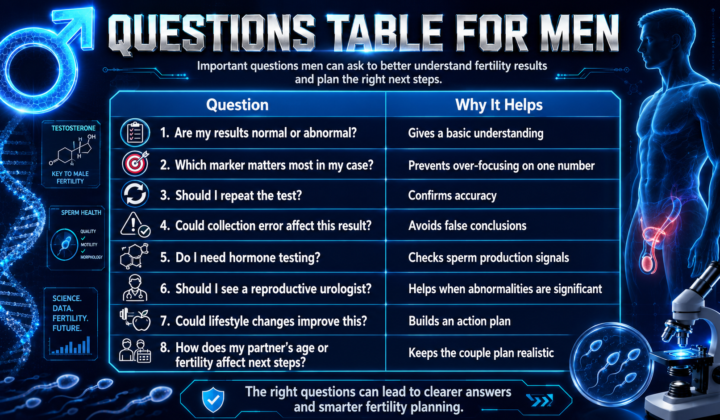
Questions Table for Men
| Question | Why It Helps |
| Are my results normal or abnormal? | Gives a basic understanding |
| Which marker matters most in my case? | Prevents over-focusing on one number |
| Should I repeat the test? | Confirms accuracy |
| Could collection error affect this result? | Avoids false conclusions |
| Do I need hormone testing? | Checks sperm production signals |
| Should I see a reproductive urologist? | Helps when abnormalities are significant |
| Could lifestyle changes improve this? | Builds an action plan |
| How does my partner’s age or fertility affect next steps? | Keeps the couple plan realistic |
What to Do If Results Are Abnormal
If results are abnormal, the first step is not panic.
The first step is review.
A doctor may recommend repeating the test.
If the abnormality continues, the next step depends on the pattern.
Low count may need hormone testing, physical exam, lifestyle review, or further workup.
Low motility may need lifestyle review, infection evaluation, varicocele assessment, or repeat testing.
No sperm may need specialist evaluation, hormone testing, genetic testing, and imaging.
Abnormal morphology may need careful interpretation.
The right move depends on the full picture.
Lifestyle Changes Before Retesting
Many doctors may recommend lifestyle improvements before repeating a semen analysis, especially if abnormalities are mild or risk factors are obvious.
Sperm development takes time.
A 90-day window is often useful for habit change.
Men should focus on the basics.
Quit smoking.
Reduce alcohol.
Improve sleep.
Eat better.
Train consistently.
Lose excess body fat gradually.
Avoid heat exposure.
Stop anabolic steroids and testosterone misuse with medical guidance.
Manage stress.
These steps support the environment where sperm develop.

90-Day Semen Analysis Retest Plan
| Timeline | Main Focus | Action |
| Days 1 to 15 | Remove obvious risks | Stop smoking, reduce alcohol, avoid hot tubs and heat exposure |
| Days 16 to 30 | Improve sleep | Set a consistent sleep schedule and reduce late-night screen use |
| Days 31 to 45 | Upgrade nutrition | Add protein, fruits, vegetables, healthy fats, zinc, and selenium foods |
| Days 46 to 60 | Train smart | Strength train, walk daily, avoid overtraining |
| Days 61 to 75 | Review health | Discuss medications, hormones, symptoms, and risk factors with a doctor |
| Days 76 to 90 | Prepare for retest | Follow abstinence and collection instructions carefully |
| After 90 days | Repeat testing if advised | Compare results and plan next steps |
How Lifestyle Can Affect Semen Results
Lifestyle is not the only cause of fertility problems, but it can affect semen quality.
Smoking may harm sperm quality.
Heavy alcohol may affect hormones and sperm production.
Poor sleep may weaken recovery and hormone patterns.
Obesity may affect inflammation and reproductive health.
Heat exposure may affect sperm production.
Steroids and external testosterone may suppress sperm production.
Poor nutrition may reduce antioxidant and micronutrient support.
A man cannot control every medical cause.
But he can control many daily inputs.
That is where discipline enters.
The Role of Diet Before a Semen Analysis
A man should not expect one healthy meal to transform a semen analysis.
But over weeks and months, nutrition can support the body.
A fertility-supportive diet includes protein, healthy fats, fruits, vegetables, quality carbohydrates, minerals, and hydration.
Men should focus on foods that support overall health and reduce oxidative stress.
Eggs, fish, lean meat, Greek yogurt, legumes, berries, citrus, leafy greens, tomatoes, olive oil, nuts, seeds, and whole-food carbohydrates can all fit.
Supplements may help some men, but food and lifestyle come first.
Heat, Saunas, and Test Results
Sperm production is sensitive to temperature.
If a man has fertility concerns or abnormal semen results, reducing unnecessary heat exposure is practical.
This may include hot tubs, long hot baths, frequent sauna use, heated seats, tight underwear, or laptops on the lap.
This does not mean heat is the only cause.
It means heat is one of the easier risks to control.
A disciplined man removes easy obstacles.
Emotional Pressure Around Testing
A male infertility test can feel heavy.
Men may worry about what results say about them.
They may fear disappointing their partner.
They may feel shame.
Those feelings are human, but they should not control the decision.
A semen analysis does not define a man.
It gives information about a biological function.
That information can lead to improvement, treatment, or next steps.
Avoidance creates more pressure.
Clarity reduces it.
The mindset behind The Alpha Reports applies here because real strength includes the courage to face uncomfortable truth.
Semen Analysis and Relationships
Fertility testing can either divide a couple or bring them closer.
A man should not make his partner carry the fertility journey alone.
He should get tested when needed.
He should discuss results calmly.
He should avoid blame.
He should support her emotionally.
He should improve his own health.
He should treat fertility as a shared mission.
A man who wants fatherhood should start practicing responsibility before the child exists.
Semen Analysis Does Not Measure Masculinity
This point needs to be said clearly.
A semen analysis does not measure masculinity.
It measures semen and sperm.
That is all.
Masculinity is shown in how a man responds.
Does he hide?
Does he blame?
Does he delay?
Or does he take action?
A man who gets tested, improves his habits, supports his partner, and follows medical guidance is acting with strength.
A man who avoids reality because of pride is not.

The Alpha Standard for Male Fertility Testing
The Alpha standard is simple.
Stop guessing.
Get facts.
Act with discipline.
Protect your future.
Do not wait until pressure forces you to care.
Do not assume fertility is fine because performance is fine.
Do not make your partner carry the burden alone.
Do not use supplements to avoid testing.
Do not hide hormone or steroid use from your doctor.
Do not panic over one result.
Review, repeat, and respond.
That is how a serious man handles fertility.
It fits the wider philosophy of Alpha Circle Club, where discipline is not motivation for one day. It is a standard for life.
Common Myths About Semen Analysis
Myth 1: If I Ejaculate Normally, My Sperm Are Healthy
Normal ejaculation does not prove sperm health.
A man can ejaculate normally and still have low sperm count, poor motility, abnormal morphology, or no sperm in the semen.
Only testing can show what is happening.
Myth 2: A Semen Analysis Is Only Needed After Years of Trying
Waiting too long can waste time.
Many couples should seek evaluation after 12 months of trying, or after 6 months if the female partner is 35 or older.
Men with risk factors may need testing earlier.
Myth 3: One Abnormal Result Means I Am Infertile Forever
Not always.
Semen results can vary.
Doctors may repeat testing before drawing conclusions.
Some abnormalities are temporary or treatable.
Myth 4: Sexual Performance Equals Fertility
Performance and fertility are different.
Erections, libido, and ejaculation do not guarantee sperm count, motility, or morphology.
Myth 5: Supplements Are Better Than Testing
Supplements may help some men, but they do not replace testing.
A man needs to know the problem before choosing the solution.
FAQs About Semen Analysis
What is a semen analysis?
A semen analysis is a lab test that checks semen and sperm.
It usually measures semen volume, sperm count, sperm concentration, sperm movement, sperm shape, and other semen markers.
Is semen analysis the same as a sperm test?
Yes, many people call it a sperm test, sperm count test, or male fertility test.
The medical term is semen analysis because the test evaluates both semen fluid and sperm cells.
Why would a man need a semen analysis?
A man may need testing if a couple is struggling to conceive, if he has fertility risk factors, or after a vasectomy to confirm that sperm are absent.
Some men also test proactively before trying for children.
How do I prepare for a semen analysis?
Follow the clinic’s instructions.
This usually includes avoiding ejaculation for a recommended period, using the proper sterile container, collecting the full sample, avoiding unapproved lubricants, and delivering the sample on time.
What does sperm count mean?
Sperm count measures how many sperm are present.
A lower count may reduce the chance of conception, but count should be interpreted with motility, morphology, volume, and the full fertility picture.
What does sperm motility mean?
Sperm motility means how well sperm move.
Progressive motility is especially important because sperm need to move forward to reach the egg.
What does sperm morphology mean?
Sperm morphology means sperm shape.
Abnormal morphology may affect fertility in some cases, but it should be interpreted carefully with the rest of the semen analysis.
Can semen analysis results change over time?
Yes.
Semen quality can vary due to illness, fever, stress, abstinence time, heat exposure, medications, lifestyle, and collection issues.
Doctors may repeat testing if results are abnormal.
What happens if no sperm are found?
If no sperm are seen, the condition may be called azoospermia.
The test may need to be repeated, and a specialist may evaluate whether sperm production is low or whether a blockage is preventing sperm from entering semen.
Can lifestyle improve semen analysis results?
Lifestyle may help some men improve sperm health.
Important steps include quitting smoking, reducing alcohol, improving sleep, eating well, managing weight, reducing heat exposure, avoiding anabolic steroids, and managing stress.
Should I see a doctor after abnormal results?
Yes.
Abnormal results should be reviewed with a qualified clinician.
Depending on the pattern, the doctor may recommend repeat testing, hormone bloodwork, physical exam, ultrasound, genetic testing, infection testing, or treatment.
Final Thoughts
A semen analysis is not something men should fear.
It is one of the clearest tools available for understanding male fertility.
It checks sperm count, sperm movement, sperm shape, semen volume, and other important markers.
It does not define a man.
It informs him.
A man who wants children should not rely on ego, assumptions, or bedroom confidence.
He should know the truth.
If results are normal, he gains clarity.
If results are abnormal, he gains direction.
Either way, testing creates power because it replaces uncertainty with information.
The strongest men are not the ones who avoid uncomfortable topics.
They are the ones who face them, learn from them, and act.
Get tested when needed.
Follow instructions properly.
Review results with a clinician.
Repeat the test if advised.
Improve your habits.
Protect your fertility.
Support your partner.
Build the future with discipline.
That is the Alpha standard.

Medical note: This article is for educational purposes only and is not medical advice. Men concerned about fertility, testosterone, semen quality, or conception should speak with a qualified healthcare professional or fertility specialist.



No spam. Unsubscribe anytime.